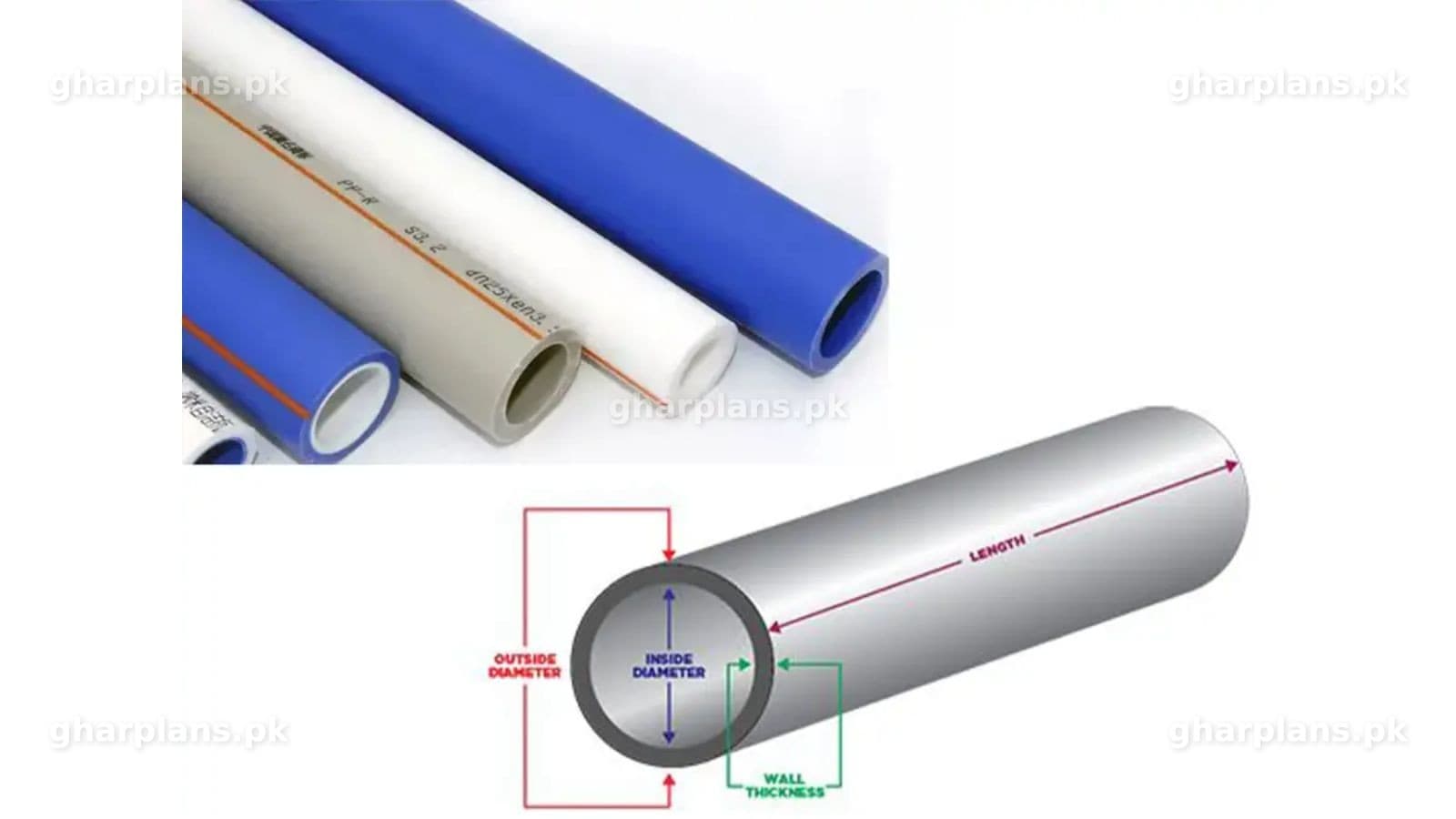
Avoid Buying Sub-Standard PPRC Pipes & Fittings
How to Avoid Buying Sub-Standard PPRC Pipes & Fittings. Whether you are building your house or you are a professional plumber, it is important for you to be able to evaluate the quality of pipe by yourself. Off course, you don’t have a lab where you can test the pipe as per the laid down standards. There are many standards which are specifically applicable to PPRc pipes including ISO, DIN, ASTM, BS, PS etc.
These standards define the quality and performance parameters of PPR pipes and also the test methods to verify these pipes’ compliance with these standards. Although, every pipe manufacturer claims that they comply with those standards but while you live in Pakistan, you cannot trust these claims and you must make your own evaluation. Here we are giving you guidelines which have been adopted from these standards and simplified for you whereby you should be able to avoid buying poor quality pipes.
Pipe Appearance
PPR pipe made from pure, virgin, granular resin will have uniform color throughout the length of the pipe. All the pipe sections from a batch must have same color shade. Any color variation, patching or agglomeration on pipe surface will indicate that the pipe is not made from pure and virgin raw material. Color variation means it has mixing of non-specific plastics or may be it is made from recycled material. The color of the pipe can be any e.g. Green, Grey, Blue or White. All these are standard colors.
Its outer surface should be smooth but in matt finish. If outer surface is glossy, don’t buy this pipe because may be it is made from non-specific material. Non-Specific material pipe is extruded at higher temperature which turns its outer surface glossy. However, the inner surface of good quality pipe must be absolutely smooth like surface of glass. Usually for the PPR pipe with good quality its inside and outside should not have any air bubbles and obvious depressions and pin holes.
The Wall Thickness
It is very important to measure the wall thickness of the pipe. First, the wall thickness must be in accordance with the standard which is written on the pipe. Dia-wise wall thickness of the PPR pipe can be easily searched from google. Measure the wall thickness at least at two points of the pipe end. Its wall thickness should be uniform on all sides. If wall thickness on one side is higher than the other, just don’t buy it. In smaller dia pipes, wall thickness difference is difficult to detect with naked eye. Therefore, measuring with Vernier caliper is necessary.
Burn Test
Take a small piece of pipe and burn it on flame. Good quality PPR pipe burns without smoke and smell. Bad quality pipe burns with black smoke.
Sink Test
Put various pieces of PPR Pipe samples and put them in a pot full of water. Good quality PPR pipe will be more buoyant than the rest. Bad quality pipe will submerge or may completely sink at the bottom.
Heat Test
Put various brands of PPR pipe in water and gradually heat it. Once water has reached 70-80 degree, take out pieces one by one to check which pipe is softer than the other. Good quality pipe should stay stable upto 120 degree whereas poor quality pipe will soften at much lower temperature.
The Smell
Another important quality parameter of PPR pipe is that it should be odorless. Any minor smell should turn you away from buying that pipe. Keep pipe sample submerged in clean drinking water for a while and taste that water. If you feel typical smell and/or after taste of plastic, you should not use that pipe.
The Sound
Listen carefully when the PPR pipe is dropped on the ground. If the landing sound is dull, that should be real PPR pipe. Poor quality pipe will produce higher pitched sound.
Pipe and fittings are critical to appropriate functioning of your house. Poor quality pipe system will leak and seep, spoiling not only the aesthetics of your house but they will damage your house seriously. Therefore, please be careful in selecting pipe and also the plumber.
We hope that this information will be helpful for you while buying pipe for your expensive new house.
For more blogs click on the given link below:
For market update click on the given link below: